


The Ultimate Guide to Blackjack Multihand
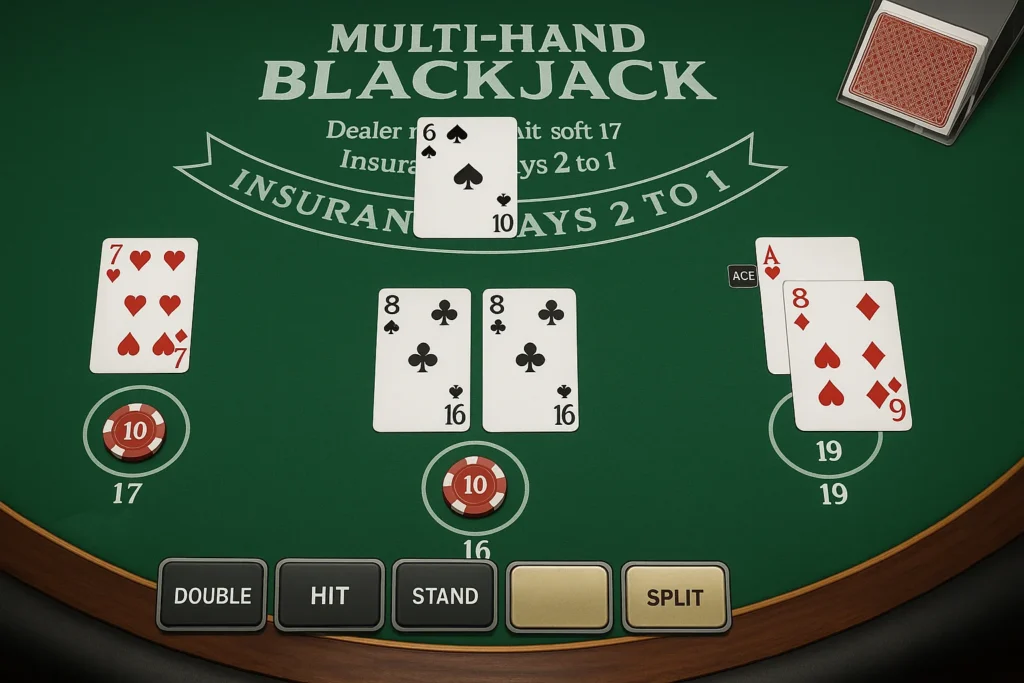
Standard blackjack is a timeless classic, but for players who want more action, faster rounds, and deeper strategic decisions, multi-hand blackjack takes the experience to a completely different level. Instead of placing a single bet and playing one hand per round, this variation lets you control up to seven hands simultaneously — each with its own bet, its own cards, and its own decisions. All of them played against one shared dealer hand.
This format transforms blackjack from a straightforward card game into a multi-layered strategic challenge. You’re no longer just deciding whether to hit or stand — you’re managing risk across several positions, balancing aggressive plays on one hand with conservative decisions on another, and watching how a single dealer card affects all your outcomes at once. It’s faster, more intense, and far more engaging than the traditional single-hand format.
In this guide, you’ll find everything you need to understand and master multi-hand blackjack: how it works, how the rules differ from classic versions, which strategies give you the best edge, how to manage your bankroll across multiple positions, and what mistakes to avoid. Whether you’re an experienced player looking for a new challenge or a beginner curious about the format, this page covers it all.
What Is Multi-Hand Blackjack?
Multi-hand blackjack is a variation of traditional blackjack where players bet on and control multiple hands in a single round, all played against one dealer hand. Most versions allow 2 to 5 hands, although some games support up to 7.
Each hand operates independently — you can hit, stand, split, or double down on each one separately. However, all hands share the same dealer outcome, which creates a unique dynamic: a strong dealer hand can wipe out all your positions at once, while a weak dealer card gives you an advantage across the entire board.
This shared-dealer mechanic is what makes multi-hand blackjack fundamentally different from simply playing several separate games. Your decisions on one hand can influence how you approach the others, especially when it comes to risk management and bet sizing.
Key Benefits
- Play 2 to 7 hands simultaneously against a single dealer
- Make independent decisions on each hand — hit, stand, split, or double
- More action per round without waiting for other players
- Test different strategies side by side in the same round
- Higher win potential when the dealer busts or has a weak card
How Multi-Hand Blackjack Works
The flow of a multi-hand round follows the same structure as classic blackjack, with a few important differences in pacing and decision-making:
- Place your bets — you set a separate wager on each hand you want to play. You can bet different amounts on different positions.
- Cards are dealt — each of your hands receives two face-up cards. The dealer receives one face-up and one face-down card.
- Play each hand — starting from the leftmost hand, you make decisions one at a time: hit, stand, double down, or split. Each hand is resolved independently before moving to the next.
- Dealer reveals and plays — once all your hands are complete, the dealer flips the hole card and plays according to fixed rules (typically hitting on 16 or less, standing on 17 or more).
- Results are calculated — each of your hands is compared against the dealer’s final total. Wins, losses, and pushes are applied to each position separately.
Basic Rules
The foundational rules are the same as in any standard blackjack game:
- Objective: Get a hand value closer to 21 than the dealer without going over.
- Card values: Number cards are worth face value, face cards (J, Q, K) are worth 10, and Aces count as 1 or 11 — whichever is more favorable.
- Blackjack: An Ace plus a 10-value card on the initial deal. Pays 3:2 in most versions.
- Bust: Going over 21 means an automatic loss, regardless of what the dealer has.
Standard Rules
- Blackjack pays 3:2
- Played with 1 to 8 decks (6 is most common)
- Dealer hits or stands on soft 17 (varies by game version)
- Each hand requires a separate bet
- Insurance is offered when the dealer shows an Ace
Variable Rules by Game Version
| Rule | Possible Settings |
|---|---|
| Surrender | Yes / No |
| Double After Split | Allowed / Not Allowed |
| Dealer Hits on Soft 17 | Yes / No |
| Number of Hands | 2 to 7 |
| Deck Count | 1 to 8 |
| Re-split Aces | Allowed / Not Allowed |
Before playing any version, check the specific rule set — small differences like whether the dealer hits or stands on soft 17 can shift the house edge by 0.2% or more.
Multi-Hand vs Classic Blackjack
Both versions share the same core rules, but the playing experience is quite different. Classic blackjack suits players who prefer a slower, more focused approach — one hand, one decision at a time. Multi-hand blackjack appeals to those who want more action per round, faster sessions, and the ability to spread risk across several positions.
| Feature | Classic Blackjack | Multi-Hand Blackjack |
|---|---|---|
| Hands per round | 1 | Up to 7 |
| Game pace | Moderate | Fast |
| Bankroll management | Simple | More complex |
| Win potential per round | Standard | Higher |
| Risk per round | Moderate | Higher |
| Strategic depth | Standard | Deeper — decisions interact across hands |
| Best for | Beginners, methodical players | Experienced players, action seekers |
Neither format is objectively better — it depends on your playing style, bankroll size, and how much action you prefer per session.
House Edge and RTP
The house edge in multi-hand blackjack is determined by the same factors as classic blackjack: number of decks, dealer rules, payout ratios, and whether surrender or double-after-split is allowed. Playing multiple hands does not change the mathematical edge per hand — each position has the same expected return as a single-hand game with identical rules.
However, playing multiple hands does affect variance. With more positions active, your results in a single round are less extreme — you’re more likely to win some and lose some, rather than having an all-or-nothing outcome. Over a session, this means smoother bankroll fluctuations but also less dramatic swings in either direction.
| Factor | Effect on House Edge |
|---|---|
| Fewer decks (1–2) | Lower edge (better for player) |
| Dealer stands on soft 17 | Lower edge (better for player) |
| Double after split allowed | Lower edge (better for player) |
| Surrender available | Lower edge (better for player) |
| Blackjack pays 6:5 instead of 3:2 | Higher edge (worse for player) |
| More decks (6–8) | Slightly higher edge |
The best multi-hand blackjack games have an RTP above 99.5%, which translates to a house edge below 0.5%. Always check the paytable and rule summary before playing — the difference between a 99.6% and a 99.1% RTP game adds up significantly over hundreds of hands.
Best Multi-Hand Blackjack Games and Providers
Not all multi-hand blackjack games are created equal. Differences in RTP, deck count, rule sets, and interface quality can significantly affect your experience. Below are the most popular versions from trusted providers:
| Game | Provider | Max Hands | Decks | RTP | Highlights |
|---|---|---|---|---|---|
| Multi-Hand Blackjack | Microgaming | 5 | 5 | 99.60% | Smooth animations, classic design |
| Vegas Downtown Multi-Hand | Playtech | 3 | 2 | 99.62% | Lowest house edge, fast gameplay |
| Blackjack Multihand VIP | iSoftBet | 3 | 6 | 99.40% | High bet limits, VIP tables |
| Multi-Hand Blackjack Pro | NetEnt | 3 | 6 | 99.50% | Polished UI, excellent on mobile |
| Multi-Hand Classic Blackjack | Betsoft | 5 | 4 | 99.54% | Flexible bet range, clean graphics |
| Multihand Blackjack | BGaming | 3 | 6 | 99.59% | Fast rounds, crypto-friendly casinos |
When choosing a game, prioritize RTP above 99.5% and look for versions where the dealer stands on soft 17 and double-after-split is allowed. These two rules alone can reduce the house edge by 0.3–0.4%.
Basic Strategy
Using proper basic strategy is the single most important thing you can do to improve your results. Basic strategy is a mathematically optimal set of decisions for every possible hand combination against every possible dealer upcard. It doesn’t guarantee wins, but it minimizes the house edge to its lowest possible level.
In multi-hand blackjack, basic strategy applies to each hand independently — you should make the optimal decision for each position regardless of what’s happening on your other hands. The temptation to “play it safe” on one hand because another hand is strong is a common mistake that costs players money over time.
Core Guidelines
- Always split Aces and 8s — two separate hands with an Ace or 8 have much better expected value than one hand of 12 or 16.
- Never split 10s or 5s — a total of 20 is already strong, and two 5s are better played as a 10 (double down candidate).
- Double down on 11 against dealer’s 2 through 10 — this is one of the most profitable plays in blackjack.
- Stand on hard 17 or higher — the risk of busting outweighs the potential benefit of improving.
- Hit 12–16 when the dealer shows 7 or higher — the dealer is likely to make a strong hand, so you need to try to improve.
- Stand on 12–16 when the dealer shows 2–6 — the dealer is more likely to bust, so avoid risking your own hand.
- Stand on soft 19 (Ace + 8) or higher — already a strong total.
- Never take insurance — it’s a side bet with a negative expected value in almost all situations.
Quick Strategy Reference
| Your Hand | Dealer Shows | Action |
|---|---|---|
| Hard 8 or less | Any | Hit |
| Hard 9 | 3–6 | Double |
| Hard 10 | 2–9 | Double |
| Hard 11 | 2–10 | Double |
| Hard 12 | 2–3 | Hit |
| Hard 12 | 4–6 | Stand |
| Hard 13–16 | 2–6 | Stand |
| Hard 13–16 | 7–Ace | Hit |
| Hard 17+ | Any | Stand |
| Soft 17 (A+6) | 3–6 | Double |
| Soft 17 (A+6) | 7–Ace | Hit |
| Soft 18 (A+7) | 2, 7, 8 | Stand |
| Soft 18 (A+7) | 3–6 | Double |
| Soft 18 (A+7) | 9–Ace | Hit |
| Soft 19–20 | Any | Stand |
| Pair of Aces | Any | Split |
| Pair of 8s | Any | Split |
| Pair of 10s | Any | Stand (never split) |
Bankroll Management
Bankroll management becomes significantly more important in multi-hand blackjack because each hand requires a separate bet. Playing 5 hands at $10 each means you’re risking $50 per round, not $10. If you split or double on any of those hands, a single round can cost $80–$100 or more. Without a clear bankroll plan, you can burn through your session budget much faster than expected.
Sizing Your Bets
A common guideline is to keep your total bet per round (across all hands) below 2–3% of your total session bankroll. For example, if your bankroll is $500, your total combined bet across all hands should stay around $10–$15 per round. This gives you enough runway to absorb losing streaks without going bust prematurely.
| Session Bankroll | Hands Played | Suggested Bet per Hand | Total per Round |
|---|---|---|---|
| $200 | 2 | $2–$3 | $4–$6 |
| $500 | 3 | $3–$5 | $9–$15 |
| $1,000 | 5 | $4–$6 | $20–$30 |
| $2,000+ | 5–7 | $5–$10 | $25–$70 |
Betting Systems
No betting system can overcome the house edge, but some approaches help you structure your play and manage variance:
- Flat betting — same amount every hand. The simplest and most sustainable approach. Best for beginners and long sessions.
- Paroli (positive progression) — double your bet after a win, reset after a loss or three consecutive wins. Capitalizes on hot streaks without risking too much.
- Martingale (negative progression) — double after every loss to recover. Mathematically sound in theory but dangerous in practice — a losing streak can escalate bets beyond table limits or bankroll capacity very quickly.
- 1-3-2-6 system — a structured progression where you bet 1 unit, then 3, then 2, then 6, resetting after a loss or completing the cycle. Limits downside while capturing profit from winning streaks.
Regardless of which system you use, the most important rule is to set a session budget before you start and stop when you reach it — win or lose.
Common Mistakes to Avoid
Multi-hand blackjack attracts both experienced players and beginners, but the format introduces several traps that can drain your bankroll if you’re not careful:
- Playing too many hands too early — start with 2–3 hands until you’re comfortable with the pace and decision-making. Jumping straight to 5 or 7 hands often leads to hasty, suboptimal decisions.
- Ignoring basic strategy on individual hands — each hand should be played according to optimal strategy, regardless of your other positions. Don’t stand on 15 against a dealer 10 just because your other hands are strong.
- Overbetting relative to bankroll — with 5 hands at $10 each plus potential splits and doubles, a single round can cost $80+. Make sure your bankroll can handle at least 30–50 rounds at your chosen bet level.
- Taking insurance — insurance is a side bet that pays 2:1 if the dealer has blackjack. Statistically, it has a negative expected value and costs you money over time. Skip it.
- Chasing losses by adding more hands — if you’re on a losing streak, adding more hands to “catch up” just increases your risk per round. Stick to your plan.
- Playing 6:5 blackjack games — some online versions pay 6:5 instead of 3:2 for a natural blackjack. This increases the house edge by roughly 1.4%. Always check the paytable before you play.
- Splitting 10s — a total of 20 wins the vast majority of hands. Splitting it into two hands of 10 gives worse expected value in almost every scenario.
Advanced Tips
- Start with fewer hands and increase gradually — 2 hands first, then 3, then 5 once you can make decisions quickly without hesitation.
- Use different bet sizes across hands — you don’t have to bet the same amount on every position. Place larger bets on the first and last positions, smaller bets in the middle, to manage variance.
- Pay attention to the dealer’s upcard before acting — the dealer’s visible card affects the optimal play for all your hands. A dealer showing 6 means you should play more conservatively across all positions.
- Track game RTPs — choose versions with 99.5% or higher. The difference between 99.1% and 99.6% compounds significantly over hundreds of hands.
- Use auto-deal or hotkeys where available — faster input means less mental fatigue and fewer errors over long sessions.
- Check bonus wagering terms before playing — many casino bonuses count blackjack at only 5–10% toward wagering requirements, making them poor choices for bonus clearing.
- Practice in demo mode first — get comfortable with the interface, speed, and decision flow before risking real money.
Playing on Mobile
Most modern multi-hand blackjack games are built with HTML5 and work seamlessly on smartphones and tablets. All the games listed in our providers table above are fully mobile-compatible and can be played directly in your mobile browser without downloading an app.
The mobile experience is nearly identical to desktop — you tap to hit, stand, double, or split, and the interface automatically adjusts to your screen size. A few things to keep in mind when playing on mobile:
- Landscape mode gives you a better view of all your hands, especially when playing 4 or more positions.
- Touch controls are responsive, but take care not to tap too quickly — accidental hits or stands can be costly.
- A stable internet connection is important. If connectivity drops mid-hand, most casinos will auto-complete the round using basic strategy, but it’s best to avoid that situation.
- Battery drain is moderate — expect about 10–15% per hour of continuous play, similar to streaming video.
Free Play and Demo Mode
Nearly every online casino that offers multi-hand blackjack also provides a free demo version. Demo mode uses virtual chips — you play with fake money, but the game mechanics, odds, and RTP are identical to the real-money version.
Demo mode is valuable for several reasons:
- Learn the interface and controls without financial risk.
- Practice basic strategy until it becomes automatic.
- Test different numbers of hands to find your comfort level.
- Compare different game versions side by side before committing real money.
- Experiment with betting systems to see how they perform over many rounds.
No registration or deposit is required in most cases — just load the game and start playing.
Pros and Cons
| Pros | Cons |
|---|---|
| More action and excitement per round | Burns through bankroll faster |
| Multiple chances to beat the dealer each round | Requires faster decision-making |
| Smoother variance — wins and losses balance out | Can be overwhelming for beginners |
| Test strategies across hands simultaneously | Errors on one hand can be distracting |
| Same RTP as single-hand blackjack | Blackjack bonus contribution is often low (5–10%) |
| Available in demo mode for free practice | Not all casinos offer the best rule variants |
Glossary
| Term | Definition |
|---|---|
| Hit | Request another card from the dealer |
| Stand | Keep your current hand and end your turn |
| Double Down | Double your bet and receive exactly one more card |
| Split | Divide a pair into two separate hands, each with its own bet |
| Bust | Going over 21 — automatic loss |
| Soft Hand | A hand containing an Ace counted as 11 (e.g., A+6 = soft 17) |
| Hard Hand | A hand without an Ace, or where the Ace must count as 1 |
| Surrender | Forfeit your hand and recover half your bet |
| Insurance | A side bet offered when the dealer shows an Ace — pays 2:1 if dealer has blackjack |
| Push | A tie between player and dealer — your bet is returned |
| RTP | Return to Player — the percentage of wagered money returned over time |
| House Edge | The casino’s statistical advantage, expressed as a percentage |
| Shoe | The device holding multiple decks of cards |
| Hole Card | The dealer’s face-down card |
Responsible Gaming
Multi-hand blackjack is fast-paced and engaging, which makes it easy to lose track of time and spending. Keeping your play enjoyable and sustainable requires a few simple habits:
- Set a session budget before you start and stop when you reach it, regardless of whether you’re winning or losing.
- Set time limits — decide how long you’ll play before you begin and stick to it.
- Don’t chase losses — increasing bets or adding more hands after a losing streak rarely works and usually accelerates losses.
- Use casino tools — most platforms offer deposit limits, loss limits, session timers, and self-exclusion options. Use them.
- Take breaks — step away after every 30–60 minutes of play to reset your focus.
- Seek help if needed — if gambling starts affecting your finances, relationships, or well-being, organizations like GamCare, Gamblers Anonymous, and BeGambleAware offer free, confidential support.
Blackjack should always be entertainment first. Play for the enjoyment of the game, not as a way to make money.
Multi-hand blackjack is a compelling evolution of one of the most popular casino games ever created. It preserves everything that makes blackjack great — simple rules, deep strategy, and a low house edge — while adding the intensity of managing several hands at once. Whether you’re drawn to the faster pace, the strategic depth, or simply the excitement of multiple hands in play, this format delivers an experience that single-hand blackjack can’t match. Master the basics, manage your bankroll, play the optimal strategy on every hand, and you’ll get the most out of every session.
Frequently Asked Questions
Can you count cards in multi-hand blackjack?
Not effectively in online games. Most online versions reshuffle the deck after every round, which eliminates the information that card counting relies on. In land-based casinos with physical shoes, it’s theoretically possible but significantly harder because multiple hands consume more cards per round, reducing the number of hands you can play before the shoe is reshuffled.
How many hands should I play at once?
Start with 2 hands if you’re new to the format, then increase to 3 once you’re comfortable making decisions quickly. Most experienced players settle on 3–5 hands as the sweet spot — enough action to be engaging without overwhelming your ability to apply basic strategy to every position.
Is there a free version available?
Yes. Nearly all online casinos that offer multi-hand blackjack provide a free demo mode. You play with virtual chips, but the rules, odds, and game mechanics are identical to the real-money version. No registration or deposit is required in most cases.
Which games offer the best odds?
Look for games with RTP above 99.5%. The best odds come from versions where the dealer stands on soft 17, double-after-split is allowed, surrender is available, and blackjack pays 3:2. Vegas Downtown Multi-Hand by Playtech (99.62% RTP) currently offers one of the lowest house edges.
Does playing more hands increase my chances of winning?
Not per hand — each individual hand has the same odds regardless of how many you play. However, playing multiple hands reduces variance: your results per round are less extreme because you’re likely to win some and lose some. Over a session, this smooths out your bankroll fluctuations but doesn’t change the overall expected return.
Is multi-hand blackjack available on mobile?
Yes. All major providers (Microgaming, NetEnt, Playtech, Betsoft, BGaming, iSoftBet) offer HTML5 versions that work in mobile browsers on both iOS and Android. No app download is required — just open the casino website on your phone and start playing.
What is the house edge in multi-hand blackjack?
It depends on the specific rules of the game version, but the best multi-hand blackjack games have a house edge between 0.35% and 0.60%. Key factors include deck count, whether the dealer stands on soft 17, and whether double-after-split and surrender are allowed.
Can I use a betting system to beat the house?
No betting system can overcome the mathematical house edge in the long run. Systems like Martingale, Paroli, or 1-3-2-6 can help you structure your bets and manage variance, but they don’t change the underlying odds. The only way to minimize the house edge is to play perfect basic strategy and choose games with favorable rules.
Should I always split Aces?
Yes — always. A pair of Aces gives you a total of 12 (since one must count as 1 to avoid busting). Splitting them gives you two hands that each start with 11 — an excellent position to draw a 10-value card for a total of 21. It’s one of the most profitable plays in the game.
What happens if my internet connection drops during a hand?
Most reputable online casinos will auto-complete the round using basic strategy or hold the game state until you reconnect. Your bets and results are recorded server-side, so you won’t lose money due to a disconnection. However, the auto-played decisions may not match what you would have chosen, so a stable connection is always recommended.